
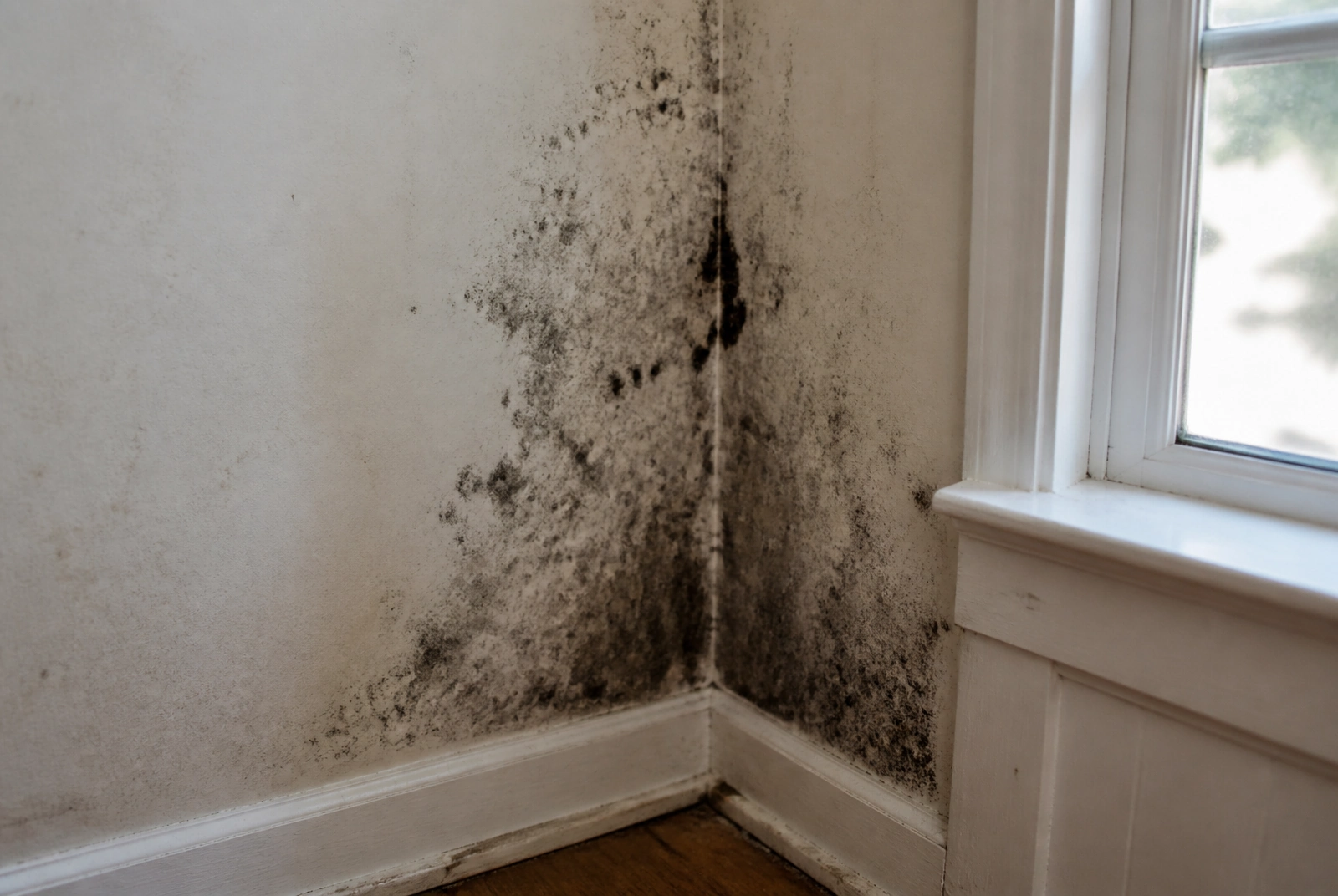
Mold is a year-round problem on the Mississippi Gulf Coast. Average relative humidity here sits high enough that indoor materials stay damp long after the visible water is gone, and warm temperatures keep growth active through most of the calendar. That combination is why a wall corner in Gulfport can develop visible growth in a matter of days while the same wall in a dry climate would never show a spot.
This guide covers what black mold actually is, how to tell whether what you are seeing is a cosmetic problem or a structural one, what removal genuinely involves, and where the line sits between a homeowner cleaning job and professional remediation.
What people mean by "black mold"
"Black mold" is a common name, not a species. Most of the time it refers to *Stachybotrys chartarum*, a dark greenish-black mold that grows on cellulose materials — drywall paper, ceiling tile, cardboard, wood — that have stayed wet for an extended period. But plenty of other molds are also dark in color, including Cladosporium and Aspergillus varieties that are far more common in Gulf Coast homes.
Practically speaking, the color does not change what you should do. You cannot identify a species by looking at it, and the remediation approach for a given amount of growth is the same regardless of which mold is present. What matters is:
- How much area is affected
- What material it is growing on
- Whether the moisture source has been stopped
That last point is the one homeowners skip most often, and it is the reason mold comes back.
Why Gulf Coast homes are so vulnerable
Several regional factors stack against property owners here:
- Sustained humidity. Outdoor relative humidity along the coast frequently sits above 70 percent. Air conditioning removes some indoor moisture, but a system that is oversized short-cycles and never runs long enough to dehumidify properly.
- Crawl spaces and slab construction. Vented crawl spaces pull humid outdoor air underneath the home, where it condenses on cooler surfaces. Slab homes wick moisture upward through the concrete into flooring and baseboard.
- Storm and flood history. Wind-driven rain, roof leaks, and flood intrusion introduce large volumes of water into wall cavities that never get properly dried.
- Long shoulder seasons. There is no hard freeze to slow growth down for months at a time.
The result is that moisture problems in this region rarely resolve on their own. Left alone, they compound.
Health risks: what the evidence supports
There is a lot of exaggerated material online about black mold. Here is the measured version, consistent with CDC and EPA guidance:
Mold exposure commonly causes respiratory irritation — coughing, wheezing, nasal congestion, throat irritation, and eye irritation. People with asthma, allergies, or compromised immune systems tend to react more strongly and at lower exposure levels. Infants, older adults, and anyone undergoing treatment that suppresses immune function are in a higher-risk group.
Claims that a specific mold species causes severe systemic illness in otherwise healthy people are not well supported by current public health evidence. That said, the sensible conclusion has not changed: you should not live with active indoor mold growth, and the goal is to remove it and fix the moisture, not to test which species it is.
If someone in the household is experiencing persistent symptoms that improve when they leave the home, that is worth discussing with a physician — a restoration company cannot and should not offer a medical opinion.
How to tell how bad it is
Use these signals to gauge severity:
Likely a smaller, surface-level problem:
- Growth confined to non-porous surfaces like tile, grout, glass, or finished metal
- Total affected area smaller than roughly 10 square feet
- A clear, one-time moisture source that has already been corrected
- No musty odor beyond the immediate area
Likely a job for a professional:
- Growth on drywall, insulation, carpet pad, wood framing, or ceiling tile
- Affected area larger than about 10 square feet, or growth in more than one room
- A musty smell with no visible source — this usually means growth inside a wall cavity, under flooring, or in a crawl space
- Mold that has returned after a previous cleaning attempt
- Any growth following a flood, sewage backup, or prolonged roof leak
- Mold in or near HVAC ductwork or the air handler
- A household member with asthma, a mold allergy, or a compromised immune system
Mold in ductwork deserves special mention. An HVAC system distributes air to every room; growth inside it converts a localized problem into a whole-house one. Do not run the system while investigating.
What professional mold remediation actually involves
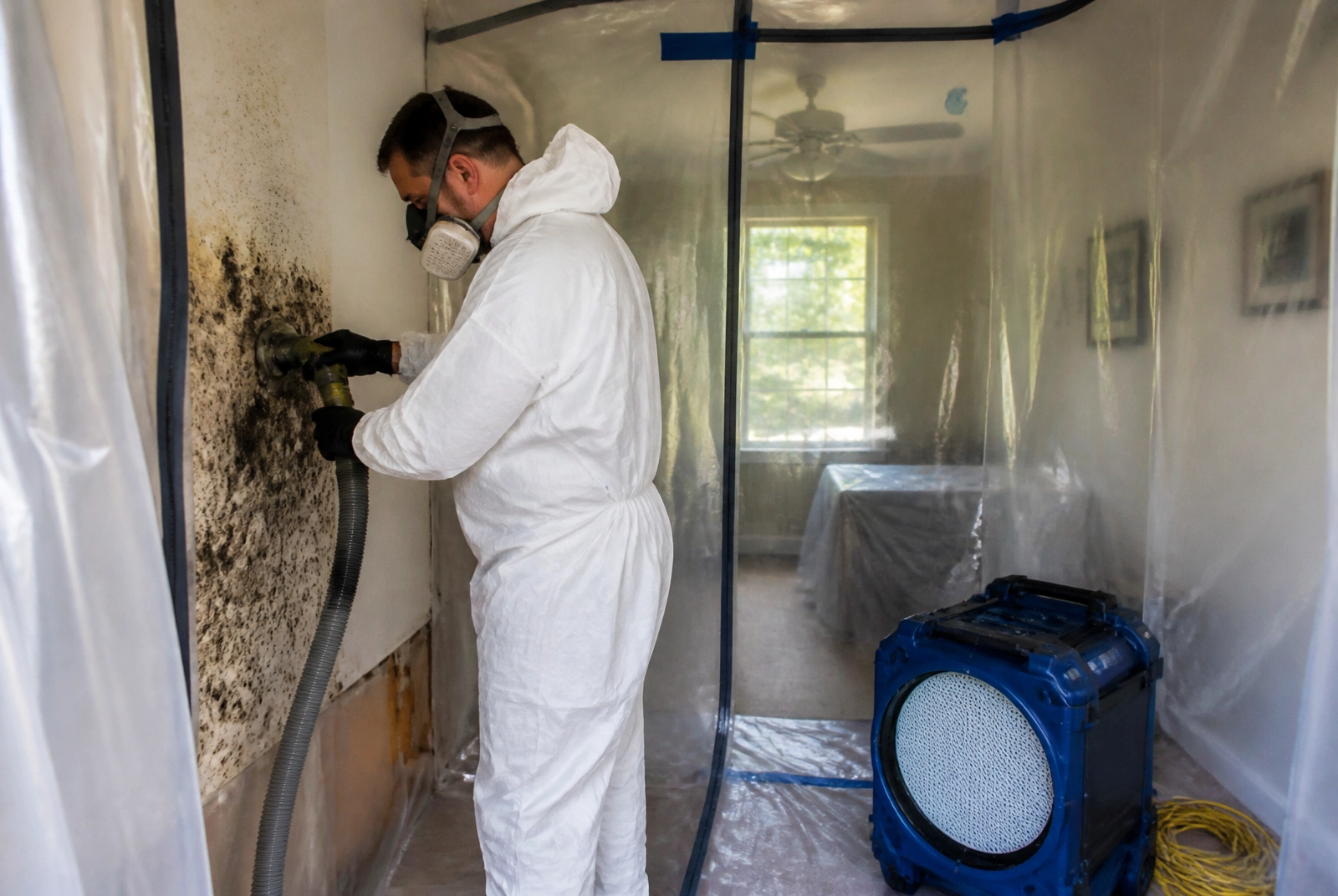
Remediation is a controlled removal process, not a spray-and-wipe. On a typical residential project, the sequence looks like this:
- Moisture investigation. Meters and thermal imaging locate the water source and map how far moisture has traveled. Skipping this step is the single most common reason mold returns.
- Containment. Plastic sheeting isolates the work area and negative air pressure keeps spores from migrating into clean parts of the home during demolition.
- Air filtration. HEPA air scrubbers run throughout the project to capture airborne particulate.
- Removal of affected materials. Porous materials with growth through them — drywall, insulation, carpet pad — are cut out and bagged rather than cleaned. Semi-porous materials like framing lumber are cleaned in place with HEPA vacuuming and abrasive methods.
- Cleaning and antimicrobial application. Remaining surfaces are cleaned, then treated. The treatment is a finishing step, not the removal method.
- Drying to a documented standard. The structure is dried until moisture content readings return to the range of comparable unaffected materials in the same building.
- Verification and documentation. Post-remediation readings, photos, and a scope record are compiled — which also matters if an insurance claim is involved.
Our mold remediation service page explains how we scope this work across the Gulf Coast, and the mold remediation near me page covers response areas and timing.
The moisture source is the actual fix
This bears repeating because it is where most mold projects fail. Mold is a symptom. If you remove the growth but leave the leaking supply line, the failed flashing, the unsealed crawl space, or the chronically over-humid interior, growth returns to the same location.
Common Gulf Coast moisture sources worth ruling out:
- Roof leaks and failed flashing around penetrations
- Wind-driven rain intrusion at windows and door thresholds
- Supply line and drain leaks under sinks and behind appliances
- HVAC condensate pans and drain lines that have backed up
- Vented crawl spaces with no vapor barrier
- Bathrooms with no working exhaust fan
- Indoor relative humidity persistently above 60 percent
A dehumidifier holding indoor humidity between 30 and 50 percent is one of the most effective long-term mold controls available to a Gulf Coast homeowner.
Prevention that actually works here
- Keep indoor relative humidity between 30 and 50 percent; a cheap hygrometer tells you where you stand
- Run bathroom exhaust fans during showers and for 20 minutes afterward
- Address any water intrusion within 24 to 48 hours — that is the window before growth typically begins
- Install and maintain a crawl space vapor barrier
- Do not carpet bathrooms, laundry rooms, or below-grade areas
- Inspect under sinks, behind the washer, and around the water heater seasonally
- Have the HVAC condensate drain cleared as part of routine service
When to call us
If growth covers more than a small area, if it is on porous building materials, if you smell must without seeing a source, or if it has come back after a cleaning attempt, that is the point to bring in a remediation crew. We respond across the Mississippi Gulf Coast and Southeast Louisiana, and we handle both the removal and the drying side so the moisture source does not simply restart the cycle.
Frequently Asked Questions
Related Services
Containment, removal, and treatment of mold-affected materials in coastal Mississippi properties.
Emergency water extraction, structural drying, and full restoration for homes and businesses across the Mississippi Gulf Coast.
Commercial dehumidification sized to the water loss and monitored throughout drying.
Crawl space water removal, drying, and moisture control.