
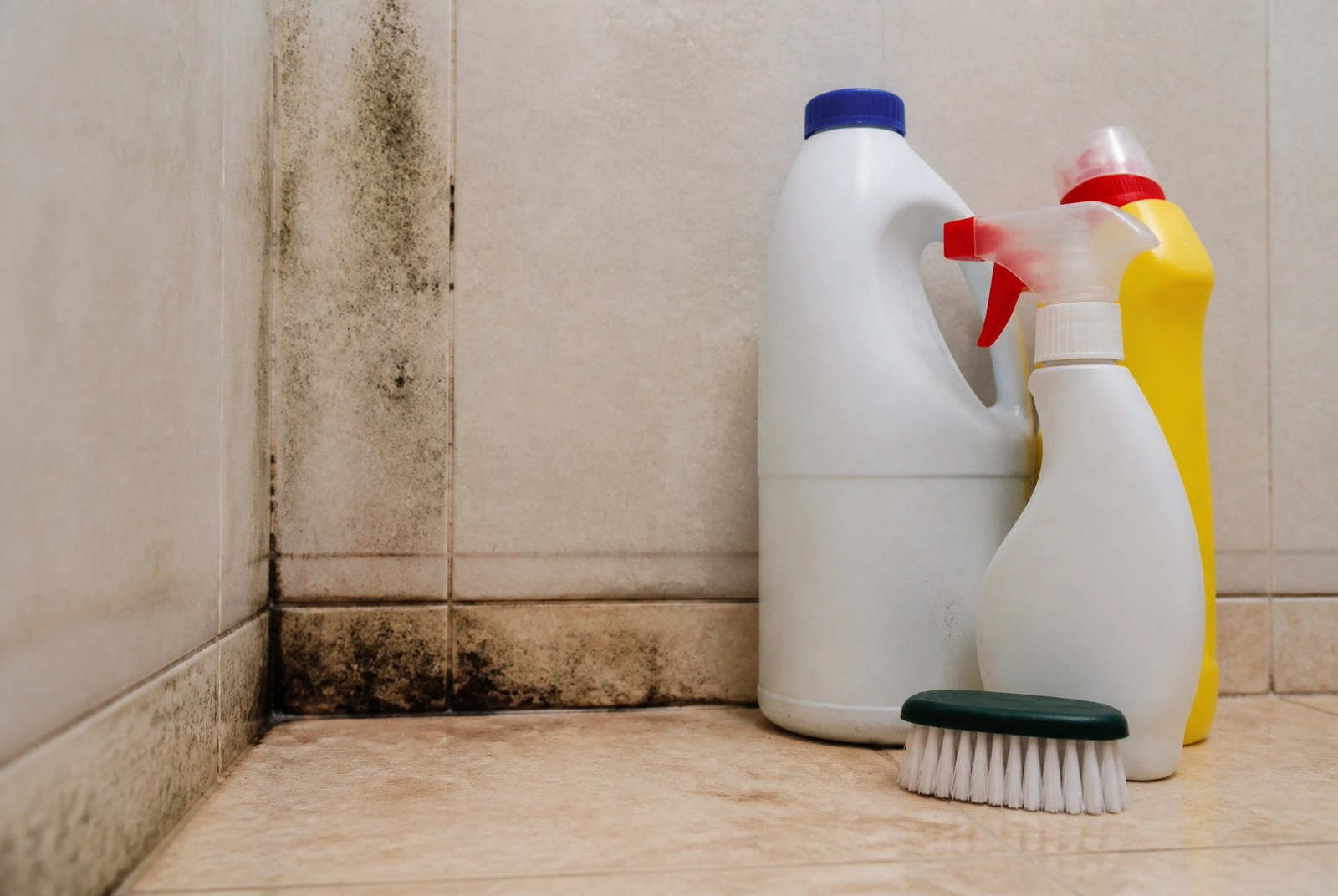
There is a framing problem in most mold advice: the question people ask is "what kills mold," when the question that determines the outcome is "what removes the growth and stops the water." A dead mold colony still sitting in a wall cavity is still an allergen source, and a treated surface with an active leak behind it will look the same in three weeks.
With that established, here is an honest evaluation of the common treatments.
Bleach (sodium hypochlorite)
Works on: non-porous surfaces — tile, grout, glass, tubs, finished metal, sealed countertops.
Does not work on: drywall, wood, insulation, carpet, ceiling tile, unsealed masonry.
Bleach is roughly 94 percent water. On a porous material, the chlorine stays near the surface while the water penetrates — which can leave the growth below fed rather than eliminated. It will remove the dark staining, which is why it *appears* to work. Neither the EPA nor mainstream restoration practice recommends bleach as the default treatment for mold on building materials.
Never mix it with ammonia or acid-based cleaners; the reaction produces toxic gas.
Detergent and water
Works on: most surfaces, as part of physical removal.
Unglamorous and genuinely effective. The mechanical action of scrubbing with a detergent solution physically removes the colony rather than trying to chemically neutralize it in place. This is the method most restoration standards point to for cleanable surfaces. Follow it with thorough drying.
White vinegar
Works on: light surface growth on non-porous surfaces.
Mildly effective, safer to handle than bleach, and reasonable for small bathroom spots. It has the same fundamental limitation: it does not penetrate porous materials. Do not expect it to resolve growth on drywall or framing.
Hydrogen peroxide (3 percent)
Works on: small surface areas on non-porous and some semi-porous materials.
Comparable to vinegar in practical effect for household use. Can bleach fabrics and some finishes — test an inconspicuous area first.
Commercial antimicrobials and biocides
Works on: cleaned surfaces, as a finishing step.
Professional-grade antimicrobials have a legitimate role — applied *after* removal and cleaning, to treat remaining surfaces. They are not a substitute for removal. Any contractor who proposes spraying an antimicrobial over existing growth and calling the job complete is skipping the part that matters.
Fogging and "mold bombs"
Works on: very little, on its own.
Fogging distributes a fine mist of antimicrobial through a space. It can be a supplementary step after remediation for odor and residual surface treatment. Used as the primary method, it does nothing about growth inside wall cavities, under flooring, or in insulation — and it leaves the moisture source untouched. Treat any offer to "fog the house" as the entire solution as a red flag.
Ozone generators
Works on: nothing you want in an occupied home.
Ozone at concentrations high enough to affect microbial growth is a respiratory irritant and unsafe for occupied spaces. It does not penetrate building materials. It can also degrade rubber, fabrics, and electronics. This is not a mold remediation method.
UV light
Works on: limited applications inside HVAC equipment.
UV-C installed in an air handler can suppress growth on the coil and drain pan it directly illuminates. It has no effect on mold elsewhere in the home and does not clean existing growth in ductwork.
Mold-resistant paint and encapsulants
Works on: clean, dry surfaces as prevention.
Encapsulants have a legitimate use sealing cleaned framing after remediation. Painting over active growth does not work — the mold grows through and the material underneath continues to break down. This is one of the most common shortcuts in a rushed flip or rental turnover, and it is visible within months.
The treatment that outperforms all of them
Moisture control. Mold requires water. Every product above is competing for second place behind removing the water source.
On the Gulf Coast that means:
- Hold indoor relative humidity between 30 and 50 percent — a dehumidifier is the most cost-effective mold control most homeowners here can install
- Correct roof leaks, window flashing failures, and plumbing leaks promptly
- Install and maintain a crawl space vapor barrier
- Run bathroom and kitchen exhaust ventilation
- Keep HVAC condensate drains clear
- Respond to any water intrusion within 24 to 48 hours
When treatment is not the right question
If growth covers more than about 10 square feet, sits on porous building materials, appears in more than one room, involves the HVAC system, or has returned after a prior treatment, the correct step is removal under containment rather than a product. Our mold remediation page describes that process, and the dehumidification services page covers the humidity control side that keeps it from recurring.
If you have already treated a spot twice and it keeps coming back, the treatment was never the problem. Call us and we will find the water.
Frequently Asked Questions
Related Services
Containment, removal, and treatment of mold-affected materials in coastal Mississippi properties.
Commercial dehumidification sized to the water loss and monitored throughout drying.
Crawl space water removal, drying, and moisture control.