
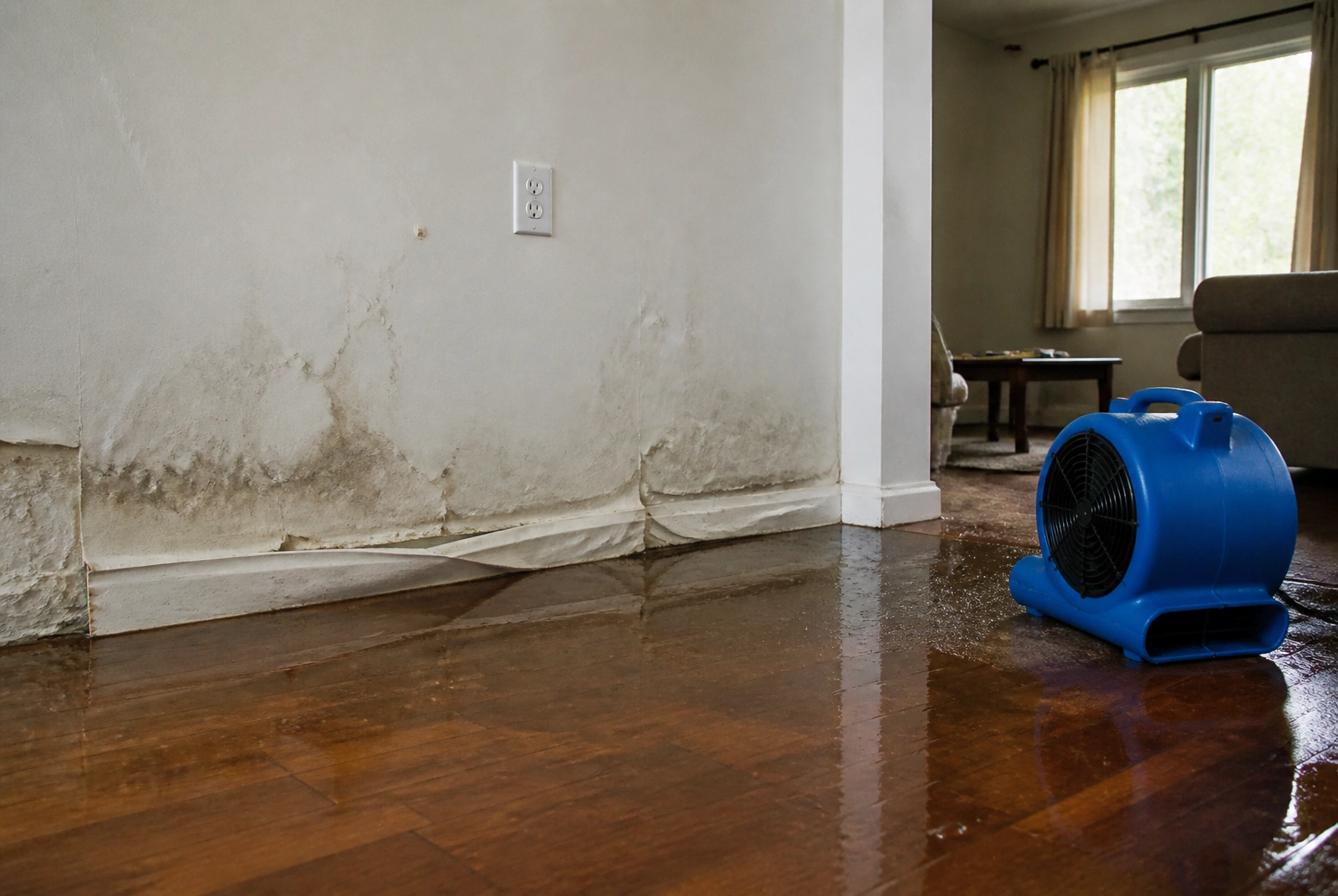
When people picture water damage they picture a flood. In practice, most residential water losses on the Mississippi Gulf Coast start inside the house: a supply line behind a washing machine, a water heater at the end of its life, a refrigerator ice maker line, a toilet supply connector, or an HVAC condensate drain that backed up into a ceiling.
These are less dramatic than a storm event, and that is exactly the problem. A slow leak in a wall cavity can run for weeks before anyone notices, and by then the material damage is well past the cost of the original repair.
What causes most home water damage
Ranked roughly by how often we see them in residential calls:
- Supply line failures — braided washing machine hoses, dishwasher lines, toilet connectors, ice maker lines. Inexpensive parts, high volume when they fail.
- Water heater failures — tanks typically fail at the bottom seam after 8 to 12 years, often while nobody is home.
- HVAC condensate issues — clogged drain lines and overflowing pans, especially in attic-mounted air handlers where the damage appears on the ceiling below.
- Drain and sewer backups — always treated as contaminated water.
- Roof and flashing leaks — common after Gulf Coast wind events, often discovered months later as a ceiling stain.
- Wind-driven rain intrusion — water forced past window and door assemblies during tropical systems.
- Slab leaks — pressurized lines under a concrete slab, often first noticed as an unexplained warm spot or a jump in the water bill.
The three categories of water
The category determines what can be saved and what has to go. This is not a judgment call a restoration company makes casually — it drives the entire scope.
Category 1 — clean water. From a sanitary source: supply lines, water heaters, ice makers, rainwater. Materials can usually be dried in place if the response is fast.
Category 2 — gray water. Contains contamination that could cause illness: dishwasher and washing machine discharge, toilet overflow without solids, aquarium water. Some porous materials come out; carpet pad generally does.
Category 3 — black water. Grossly contaminated: sewage, drain backups from beyond a trap, flood water from outside, and any water that has stood long enough to become microbially active. Porous materials in the affected area are removed. This is not a DIY situation under any circumstances.
Important detail: category degrades over time. Category 1 water sitting in warm Gulf Coast conditions for 48 to 72 hours does not stay category 1. This is a large part of why response speed changes the total cost of a loss.
What happens in the first 24 hours
What you should do:
- Stop the source. Shut off the fixture supply valve or the main water valve to the house. Learn where your main is now, not during an emergency.
- Kill power to affected areas at the breaker if water is near outlets or hardwired appliances.
- Document before you move anything. Photos and video of every affected room, the source, the water level, and the contents. This becomes your claim record.
- Move contents up and out. Lift furniture on foil or blocks, get rugs and electronics out of the water, open cabinet doors and drawers.
- Call a restoration company. The clock on secondary damage is running.
- Notify your insurance carrier. Most policies require prompt notice.
What a restoration crew does:
Extraction of standing water, moisture mapping with meters and thermal imaging to find water that traveled inside walls and under flooring, selective removal of unsalvageable materials, then placement of air movers and dehumidifiers sized to the affected volume — followed by daily moisture readings until documented dry standards are met.
Why "it looks dry" is not dry
This is the point homeowners push back on most. A hardwood floor can feel dry at the surface while the subfloor beneath it holds enough moisture to cup the boards and support mold growth. Drywall wicks water upward well past the visible stain line. Insulation inside a wall cavity holds water and dries very slowly on its own.
Professional drying is measured, not observed. Moisture meters establish a dry standard from unaffected material of the same type in the same building, and equipment stays in place until the affected material reaches it. In Gulf Coast humidity, this is why dehumidification matters as much as air movement — pushing air around a room that is already at 70 percent relative humidity accomplishes very little.
Realistic timelines
- Emergency response and extraction: same day
- Structural drying: typically 3 to 5 days, longer for hardwood, plaster, or multi-layer flooring assemblies
- Reconstruction: days to weeks depending on what was removed — drywall and paint on the short end, cabinetry and flooring on the long end
Anyone promising a fully dried structure overnight is not measuring.
Documenting a home water damage claim
The claim goes more smoothly when the record is built from the first hour:
- Photos and video before anything is moved
- The source of loss, photographed
- Written notes with dates and times of discovery and each action taken
- Receipts for anything purchased in response — tarps, fans, temporary lodging
- The restoration company's moisture logs, equipment placement records, and scope documentation
- The claim number and a log of every conversation with the carrier
Coverage decisions belong to the insurance carrier, not the restoration company. What a good contractor provides is a defensible record. Our insurance claim documentation page explains how we handle that side of a residential loss.
Preventing the next one
- Replace braided supply hoses on washing machines every 5 years
- Know the age of your water heater; plan replacement at 10 years rather than reacting at 12
- Have HVAC condensate drains cleared during routine service
- Install water leak detectors near the water heater, washer, and under sinks — inexpensive and highly effective
- Shut off the main valve before extended travel
- Keep indoor humidity between 30 and 50 percent
When to call
Call as soon as you find water, not after you have tried to manage it with towels and box fans. The difference between a call at hour two and a call at hour forty-eight is often the difference between drying materials in place and removing them. We respond 24/7 across the Mississippi Gulf Coast and Southeast Louisiana for residential water damage of every size.
Frequently Asked Questions
Related Services
Emergency water extraction, structural drying, and full restoration for homes and businesses across the Mississippi Gulf Coast.
Fast 24/7 water extraction from homes and businesses across the Mississippi Gulf Coast.
Targeted drying of framing, drywall, flooring, and structural cavities with daily moisture monitoring.
Restoration for homes, condos, and rental properties after water, storm, fire, mold, or sewage damage.