
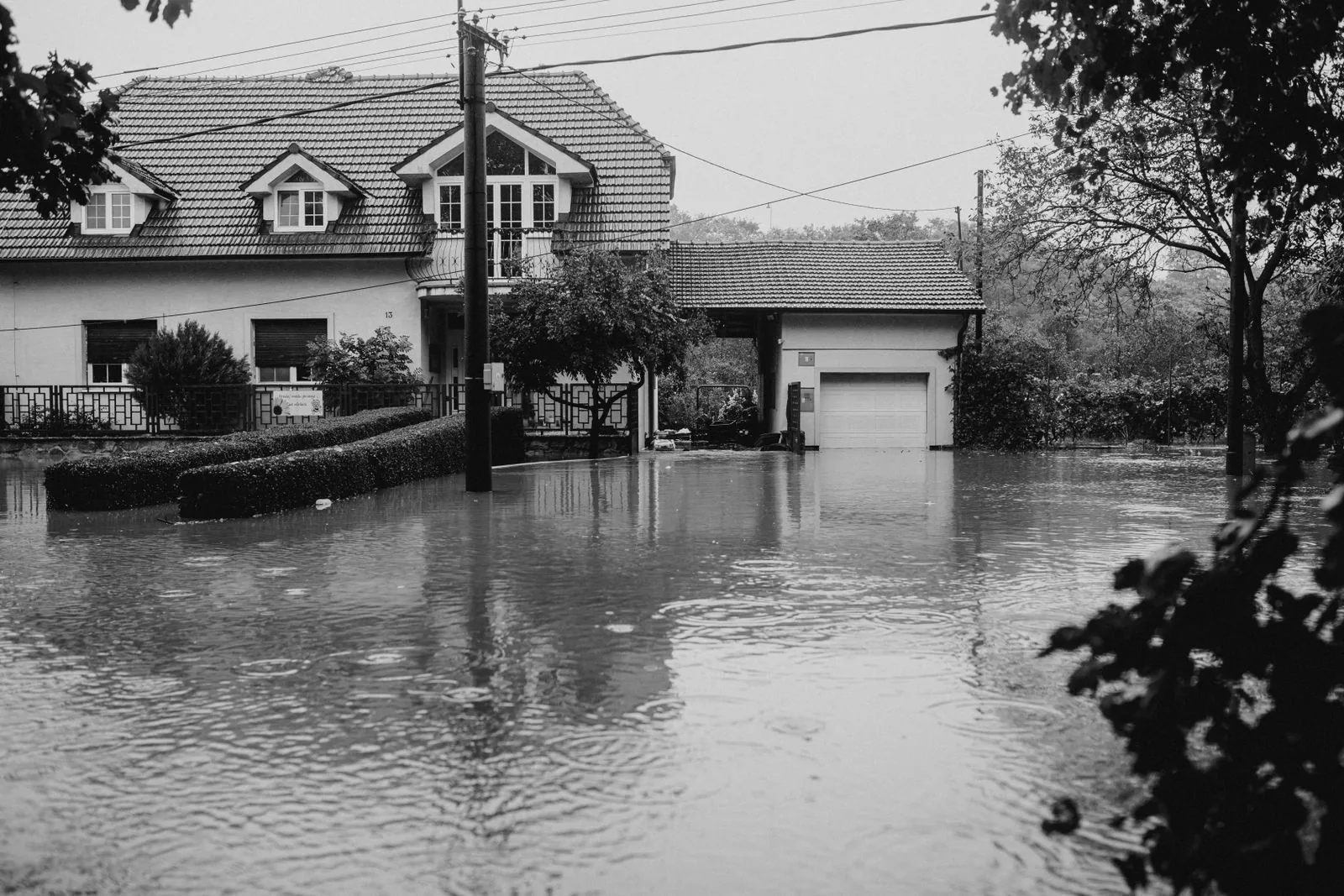
If you live anywhere from Bay St. Louis to Pascagoula, you already know how Mississippi rain works. A line of thunderstorms stalls over Hancock County, a tropical wave parks itself off Biloxi for three days, or a slow-moving low dumps eight inches on Gulfport in under twelve hours. Roads flood, yards flood, and eventually — through a door sweep, around a window, up a slab — water finds its way inside.
We have responded to thousands of these calls across Harrison, Hancock, and Jackson counties since opening Rapid Mitigation & Restoration Services. The single biggest predictor of how expensive a water loss becomes is not how much water came in. It is what the homeowner did, and didn't do, in the first 24 hours.
This is the playbook we wish every Gulf Coast homeowner had taped inside a kitchen cabinet.
Why the first 24 hours matter so much
Water is patient. Drywall paper wicks moisture vertically at roughly half an inch per hour. Carpet pad absorbs and holds water like a sponge. Engineered hardwood begins to cup within 12 to 24 hours of contact. And mold — the real cost driver in most Mississippi water losses — needs only moisture, organic material, and 24 to 48 hours to start colonizing.
The IICRC, which sets the standards every legitimate restoration company in the country follows, classifies water losses by category (1, 2, or 3, based on contamination) and class (1 through 4, based on how much porous material got wet). A Category 1 loss — clean water from a supply line — caught in the first 24 hours is usually a dry-in-place job. The same loss left for 72 hours often becomes a Category 2 (gray water) demolition job because microbial growth has already started.
In other words, the clock starts the moment water touches the floor. Not when you notice it. Not when you call insurance. Not when the rain stops.
Step 1: Stop, look, and make the space safe
Before you do anything else, slow down for thirty seconds. People get hurt in the first ten minutes after a water event more often than at any other point in the process — slip-and-fall injuries, electrical shocks, and ceiling collapses from waterlogged drywall.
Power down before you wade in
If water is anywhere near outlets, electrical panels, or the bottom of a hardwired appliance, kill power to that area at the breaker before you step in. If your panel is in a flooded room, do not touch it — call your utility. On the coast we see this most often when wind-driven rain pushes water into a low outlet on an exterior wall.
Watch the ceiling
A drywall ceiling holding water from an upstairs leak or a roof breach will sag, then bubble, then suddenly give way. If you see a bulge, get people and pets out of the room. Once it is safe and you have a bucket positioned, you can relieve the pressure by puncturing the low point of the bubble with a small screwdriver. Better a controlled drain than an uncontrolled collapse.
Floodwater is not clean
Rainwater that ran across a yard, across a road, or up through a slab is not Category 1. It picks up fertilizer, hydrocarbons, sewage from overwhelmed storm drains, and bacteria from standing puddles. Treat any water that came from outside the building envelope as contaminated. Boots, gloves, and an N95 are the minimum. Don't let kids or pets walk through it.
Step 2: Stop the source — if you safely can
The faster the water stops, the smaller the loss. For supply-line failures, the main shutoff is usually at the meter or on the wall where the line enters the house. Every adult in a Gulf Coast home should know exactly where it is before they need it. For roof and window intrusions during an active storm, you usually cannot stop the source until the weather lets up — focus on containment instead.
For slab seepage and rising groundwater after heavy rain, there is no "source" to shut off. The only meaningful action is removal: pump it out and dry the structure before the porous materials saturate.
Step 3: Document everything before you move a single thing
This is the step homeowners skip most often, and it is the step that costs them the most money on the back end. Insurance adjusters write claims from evidence. The more evidence you give them, the smoother the claim.
Before you touch anything:
- Wide shots of every affected room. Phone camera, video mode, slow pan. Narrate what you are seeing if it helps ("kitchen, water across the entire floor, baseboards wet, refrigerator on water").
- Close-ups of the water line on walls, cabinets, and furniture. The high-water mark is critical evidence.
- Photos of contents that got wet. Open drawers, photograph the contents, leave them where they are for now if they are not in standing water.
- A short video of the source if it is still visible. A burst supply line, a stained ceiling, a window with water running down the frame.
- Time-stamped — most phones do this automatically; verify yours does.
Save everything to cloud storage immediately. Wet phones happen. If a restoration company arrives before your adjuster, ask them to take their own moisture readings and photos and to share that documentation with you in writing. Every reputable mitigation firm does this as a standard part of the scope.
Step 4: Call for help in the right order
The order matters more than people realize.
- Restoration first. A qualified mitigation company can be on site faster than most adjusters and starts limiting damage immediately. Insurance expects you to mitigate — that is the homeowner's obligation under almost every policy.
- Insurance second. File the claim, get the claim number, ask who your adjuster will be. Tell them you have engaged a restoration company and mitigation is underway. You do not need their permission to begin emergency mitigation, and waiting on it is a leading cause of preventable mold growth.
- Plumber, roofer, or other source contractor third. Once water is moving in the right direction, get the underlying source repaired so the loss does not recur.
If you are not sure whether you have enough damage to file a claim, call us first. We will do a free on-site assessment, give you a written scope and moisture map, and tell you honestly whether this is a claim or a weekend project.
Step 5: Start removing water — carefully
If you have standing water and the right equipment, you can begin extraction yourself while waiting for a crew. A wet/dry shop vac works on small losses. For anything more than a square room's worth of water, wait — you are not going to make a meaningful dent and you risk hurting yourself dragging waterlogged carpet around.
What homeowners can safely do in the first hour:
- Move undamaged contents out of the affected rooms and onto a dry surface. Lift wood furniture legs out of any remaining water; aluminum foil under the feet prevents stain transfer.
- Pull up small area rugs and hang them outside if weather allows.
- Open windows if outside humidity is lower than inside (rare in Mississippi summer, but worth checking).
- Run ceiling fans and any portable fans you have, pointed across wet surfaces — not at the ceiling.
What homeowners should not do:
- Do not lift wet wall-to-wall carpet. The pad underneath disintegrates and shedding fibers becomes airborne — a respiratory hazard and a wrecked carpet.
- Do not turn on the HVAC. If water reached the air handler, return ducts, or condensate line, running the system will spread moisture and contamination through the entire house.
- Do not use a household dehumidifier and call it dry. A 30-pint consumer dehumidifier removes a few quarts a day. A single LGR commercial dehumidifier removes 20+ gallons. The difference is the difference between mold and no mold.
Step 6: Bring in the right equipment, fast
This is where professional restoration earns its keep. A correct drying setup is not just "put fans in the wet rooms." It is a calculated equation: how many cubic feet of air, at what temperature and grain depression, moving across what surface area, with how much dehumidification capacity to remove the load.
What proper structural drying looks like
A trained restoration technician walks the affected area with a moisture meter and a thermal camera, maps the moisture migration on a drawing of the floor plan, and selects equipment to match. For a typical single-room residential water loss on the coast, that is usually:
- One air mover per 10 to 16 linear feet of wet wall
- One LGR (low-grain refrigerant) dehumidifier per 1,000 to 1,500 square feet, sized to the moisture load
- Containment plastic to isolate the drying chamber from the rest of the house, so you are not paying to dry the entire structure
- Daily moisture readings to verify progress and adjust equipment placement
A good crew dries with the minimum equipment needed — not the maximum. More fans does not equal faster drying past a certain point; it just runs your electric bill up.
Find the water you can't see
This is where thermal imaging earns its place. Behind baseboards, under cabinets, inside wall cavities, above ceilings — water hides in places a flashlight will never find. A trained tech with a thermal camera and a moisture meter finds those pockets before they turn into the mold call three weeks later.
If a restoration company does not show up with thermal imaging and at least a pin and a pinless moisture meter, get a different restoration company.
Step 7: Make the demolition decision honestly
Not every water loss needs demolition. A Category 1 loss caught quickly often needs only drying, sanitizing, and reinstalling baseboards. A Category 2 loss usually needs the bottom 12 to 24 inches of drywall removed (called a "flood cut"), insulation pulled, and the cavity dried before reconstruction. A Category 3 loss — sewage, floodwater, or anything sitting more than 72 hours — almost always requires aggressive removal of porous materials.
The honest mitigation company tells you which category you are in, why, and what the IICRC S500 standard says about what should come out. If a contractor is pushing demolition on a Category 1 loss caught in eight hours, get a second opinion. If a contractor is telling you to "just dry it" on a Category 3 loss, get a second opinion.
Step 8: Track drying to a dry standard, not to a calendar
Drying is done when moisture content in the affected materials matches the moisture content of comparable unaffected materials in the same building — not when the carpet feels dry to the foot, and not when "it's been three days." The IICRC standard is documented daily moisture readings, with equipment adjusted as readings change.
A typical Mississippi residential dry-out runs three to five days. Tile-over-slab installations can take longer. Hardwood floors that didn't cup can sometimes be saved with specialized mat drying systems if started within 24 to 48 hours of the loss; floors that already cupped will usually need replacement.
Common Gulf Coast mistakes that turn a $4,000 loss into a $40,000 one
We see the same expensive mistakes repeatedly in Gulfport, Biloxi, Long Beach, Pass Christian, Bay St. Louis, Waveland, Diamondhead, Ocean Springs, and Pascagoula:
- Waiting on the adjuster before mitigating. Insurance expects you to mitigate immediately. Documented mitigation delay is one of the few legitimate reasons a carrier denies a portion of a claim.
- Renting a few box fans from the hardware store. Without dehumidification, you are evaporating water into the air and re-depositing it on cold surfaces — usually the ceiling and the wall cavities you can't see. Worse than doing nothing.
- Treating wet drywall with bleach. Bleach on a porous surface evaporates the water carrier into the wall and leaves chlorine on the paint. It does not penetrate to kill anything in the cavity. EPA-registered antimicrobials, applied after demolition, are the right tool.
- Skipping the moisture map. Without a baseline, there is no way to prove the structure was dried. A serious claim later — say, a mold issue six months out — falls apart without documentation.
What to ask any restoration company before you sign
The Mississippi Gulf Coast is full of restoration companies. After a major storm, it gets full of out-of-state storm chasers too. Before you sign anything, ask:
- Are you IICRC-certified in water damage restoration (WRT) and applied structural drying (ASD)?
- Will you provide a written scope, moisture map, and daily moisture readings as part of the job file?
- Are you direct-billing the insurance carrier, or am I paying you and getting reimbursed?
- What is your warranty on the drying work?
- Can you provide local references from within the last 60 days?
If a company can't answer those five questions in plain English, find one that can.
When to call us
Call Rapid Mitigation & Restoration Services if you have any of the following, anywhere on the Mississippi Gulf Coast or in our Southeast Louisiana service area:
- Standing water of any depth inside the structure
- Active or recent water intrusion from rain, plumbing, appliance, or roof
- Musty smell after a rain event — usually means you already have a hidden moisture problem
- Cupped, buckled, or discolored flooring
- Stained drywall or paint that wasn't there yesterday
We answer the phone 24/7, dispatch typically within 60 minutes, and provide free on-site assessments with written scopes. Call 888-870-4886 for any of our service areas, including water damage restoration in Gulfport, Biloxi, and across the coast.
The bottom line
The first 24 hours after water damage are the cheapest hours of restoration you will ever buy. Every hour after that gets more expensive — measured in materials, in labor, and in the slow creep from a clean-water loss into a mold remediation project.
Document everything, mitigate fast, and work with a company that can show you the moisture readings instead of just telling you the floor is dry. That is how Mississippi Gulf Coast homeowners come out the other side of a water loss with a house that looks the same as it did the morning before the rain started.
Frequently Asked Questions
Related Services
Emergency water extraction, structural drying, and full restoration for homes and businesses across the Mississippi Gulf Coast.
Fast 24/7 water extraction from homes and businesses across the Mississippi Gulf Coast.
Cleanup, drying, and restoration after storm surge, heavy-rain, and inland flooding events.
Containment, removal, and treatment of mold-affected materials in coastal Mississippi properties.