Water damage in Gulfport, MS is not just a coastal issue. It shows up after summer thunderstorms, slow plumbing leaks, burst pipes, appliance failures, and the flooding that can follow a tropical storm or hurricane. Because Gulfport sits in Harrison County with high humidity, warm temperatures, and a mix of slab, raised, and pier-and-beam construction, the same water loss can behave differently here than it would in a drier climate.
This guide explains what causes water damage in Gulfport homes and businesses, why fast mitigation matters, what the restoration process includes, and how to document the loss for insurance.
Common causes of water damage in Gulfport, MS
Gulfport property owners see water damage from a few repeat sources:
- Storm and wind-driven rain. Tropical systems, thunderstorms, and high winds can force water past window seals, flashing, roof penetrations, and soffits.
- Roof leaks and flashing failures. Even a small roof leak can channel water into attic insulation and wall cavities before it ever shows on a ceiling.
- Plumbing failures. Burst pipes, water heater failures, supply-line breaks, and slab leaks are common in homes of every age.
- Appliance failures. Dishwasher hoses, refrigerator water lines, and washing machine connections can release a large amount of water quickly.
- Crawl space and foundation moisture. Raised homes and properties with crawl spaces can trap moisture underneath, especially after heavy rain.
- HVAC condensate issues. Clogged drain lines and overflowing pans can cause repeated, low-level water damage over time.
No matter the source, the next steps are the same: stop the water, document the damage, remove what can be removed, and start professional drying.
Why Gulfport's climate makes speed matter
Water damage gets worse the longer it sits. In Gulfport, it gets worse faster. The combination of high humidity, warm temperatures, and coastal moisture means:
- Evaporation is slower without mechanical dehumidification.
- Mold can begin developing in 24 to 72 hours on damp drywall, wood, and insulation.
- Wood materials swell and warp quickly.
- Hidden moisture in wall cavities and crawl spaces can go unnoticed until mold or odor appears.
That is why professional water damage restoration in Gulfport starts with extraction and moisture mapping as soon as the site is safe.
What professional water damage restoration includes
A full restoration project is a sequence, not a single service. The exact scope depends on the source, the materials affected, and how long the water has been present. A typical Gulfport project includes:
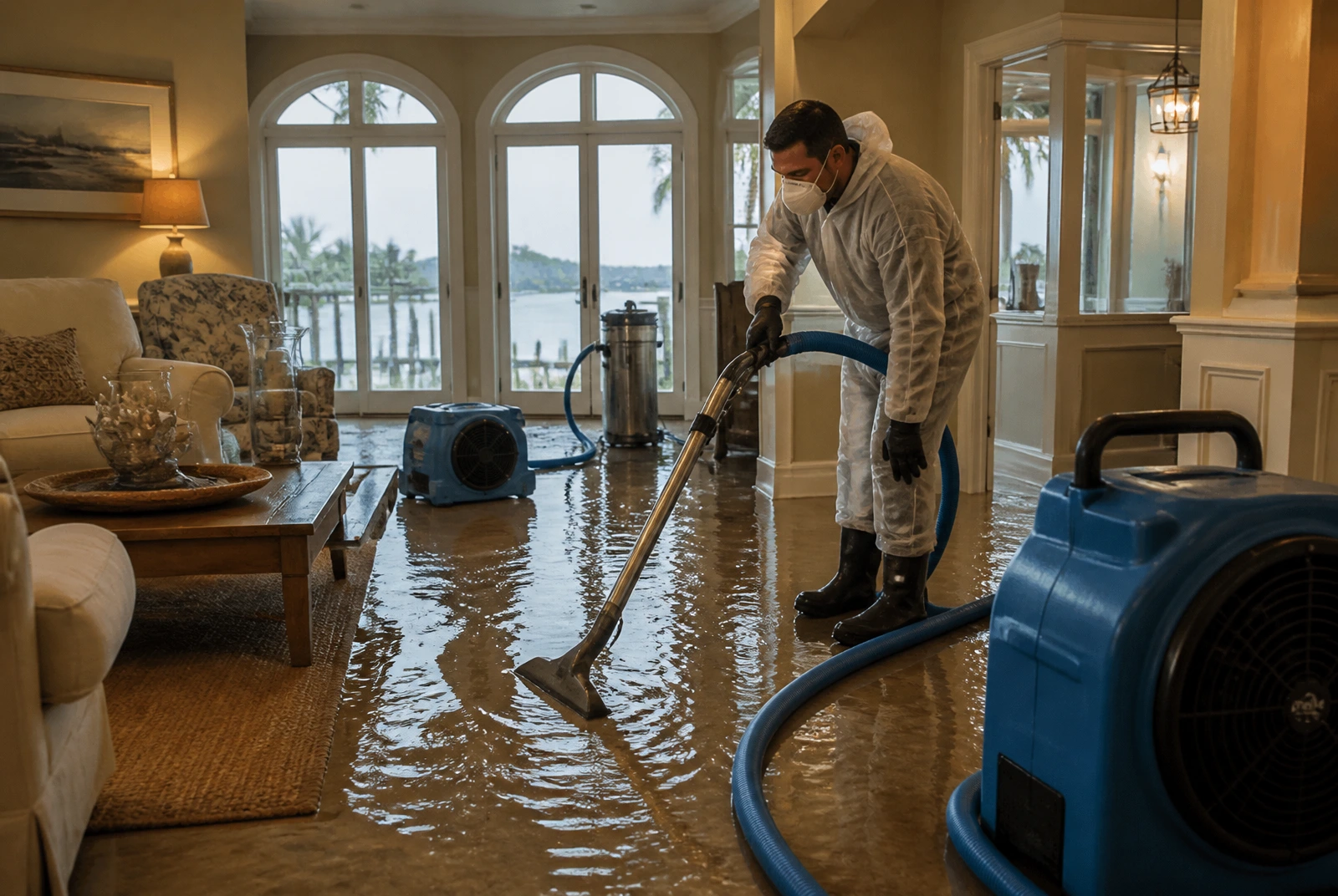
- Emergency water extraction. Truck-mounted and portable extractors remove standing water from flooring, carpet, pad, and structural cavities.
- Moisture mapping. Thermal imaging and moisture meters identify wet materials that are not visible from the surface.
- Structural drying. Air movers and commercial dehumidifiers are placed based on the affected area and the material load.
- Daily monitoring. Moisture readings are tracked until affected materials return to dry standard.
- Antimicrobial treatment. Applied where appropriate to control microbial growth on affected surfaces.
- Content protection and pack-out. Furniture, electronics, and personal items are moved or stored to prevent further damage.
- Demolition of non-salvageable materials. Saturated drywall, insulation, carpet pad, and some flooring may need removal.
- Reconstruction. Replacement of removed materials to restore the property to pre-loss condition.
- Documentation. Photos, moisture logs, and itemized invoices to support the insurance claim.
The most important part of the process is the first 24 hours. Fast extraction and proper drying prevent the kind of secondary damage that turns a small water loss into a large reconstruction project.
Water damage in Gulfport neighborhoods
Gulfport is a large city with a mix of coastal, inland, and historic areas. Different neighborhoods present different challenges:
- Downtown Gulfport and historic districts often have older plumbing, plaster and lath, and hardwood that respond differently to water than modern materials.
- Coastal and bayfront properties face salt air, storm surge risk, and wind-driven rain.
- North Gulfport and newer subdivisions may have slab foundations, engineered flooring, and tightly built envelopes that trap moisture.
- Commercial properties along Highway 49 and I-10 need fast response to minimize business interruption and protect inventory.
A restoration company that works across Harrison County regularly understands these local conditions and can adjust the drying plan accordingly.
When mold becomes a concern
Mold is not automatically present in every water loss, but it becomes a risk whenever wet materials stay damp for more than a day or two. In Gulfport, that timeline is shorter than in drier climates. If a water loss is not fully mitigated, or if hidden moisture is missed, mold can develop inside walls, under flooring, and in crawl spaces.
Professional mold remediation becomes necessary when visible mold is present, when a musty odor persists, or when moisture readings remain elevated after the initial drying period. The best way to avoid mold is to dry the structure completely the first time.
Flood damage vs. standard water damage
Not all water damage is the same from an insurance or restoration standpoint. Flood damage cleanup involves water that enters from outside the building — storm surge, overflowing creeks, or backed-up drainage. Floodwater can carry contaminants, and porous materials saturated with floodwater often need to be removed rather than dried in place.
Standard water damage usually comes from a clean or gray water source inside the building, such as a supply line, water heater, or appliance. The cleanup approach is different, and the documentation needs reflect that difference.
If you are not sure whether your loss is flood-related or plumbing-related, call for an assessment. The source affects the mitigation strategy, the equipment, and the insurance documentation.
Insurance documentation for Gulfport water losses
Insurance carriers handle water damage claims every day on the Gulf Coast, but they still need clear evidence to apply coverage. The strongest documentation packages include:
- First-arrival photos and video showing the source, water level, and affected areas
- A written scope listing every material affected and the plan to dry or remove it
- Daily moisture logs and equipment readings showing drying progress
- Itemized invoices separating emergency mitigation from reconstruction
- Content inventories and condition reports for damaged personal property
We do not make coverage decisions, but we can provide the documentation that helps the carrier apply whatever coverage the policy provides. See our insurance claim assistance page for how we support the process.
What to do before the crew arrives
If you discover water damage in your Gulfport home or business, take these steps as long as they are safe:
- Turn off power to affected areas if water is near outlets, panels, or appliances.
- Stop the water source if you can find it — shut off a fixture valve or the main water supply.
- Take photos and video before moving anything.
- Move furniture and personal items out of the wet area, or place foil under legs.
- Open drawers and cabinet doors to improve airflow.
- Call your insurance carrier to report the loss and get a claim number.
- Call a restoration company that responds 24/7 across Gulfport and Harrison County.
Do not try to fully dry a saturated structure with household fans. Do not remove wall-to-wall carpet yourself. And do not assume the water is gone just because it is no longer visible.
When to call a water restoration company in Gulfport
Call as soon as you notice the loss. The first 24 hours are the most important. Even if the water looks manageable, hidden moisture can remain in subfloor, wall cavities, and insulation. In Gulfport humidity, that hidden moisture can cause more damage than the water you can see.
Rapid Mitigation & Restoration Services provides 24/7 water damage restoration across Gulfport, Biloxi, Long Beach, Pass Christian, and the rest of the Mississippi Gulf Coast. We handle emergency water extraction, structural drying, mold prevention, and reconstruction.
The bottom line
Water damage restoration in Gulfport, MS is about acting fast, drying thoroughly, and documenting everything. The Gulf Coast climate does not give property owners much time before secondary damage begins. The property that starts mitigation within the first day is almost always the property that costs less and returns to normal faster. If you have active water damage or questions about the process, call us at any time.
Frequently Asked Questions
Related Services
Emergency water extraction, structural drying, and full restoration for homes and businesses across the Mississippi Gulf Coast.
Fast 24/7 water extraction from homes and businesses across the Mississippi Gulf Coast.
Cleanup, drying, and restoration after storm surge, heavy-rain, and inland flooding events.
Containment, removal, and treatment of mold-affected materials in coastal Mississippi properties.